
When you operate at scale—serving diverse OEMs with over 45,000 SKUs—complexity becomes embedded in the system. But unmanaged complexity often translates into invisible inefficiencies, suboptimal throughput, and excess manpower without proportional output.
This Operational Excellence transformation was not about incremental improvement—it was a ground-up execution-led reset, designed to restore flow, discipline, and real-time visibility across the shopfloor.
Kluger Kopf was brought in with a clear mandate— not just to improve productivity, but to bring discipline, structure, and flow back to the shopfloor.
What followed over the next three months was not a typical consulting intervention.
It was a ground-up operational reset.
The Starting Point: A System Running Without Feedback
At first glance, the plant was busy. Machines were running, people were occupied, and output was happening.
But a deeper look revealed a different story.
There was no linkage between effort and outcome. Operators didn’t know their hourly targets. Supervisors couldn’t measure achievement in real time. The absence of daily targets vs. actual tracking meant there was no performance culture—only activity.
The production flow itself was fragmented.
There was no concept of single-line flow, leading to excessive movement of parts, higher WIP, and frequent line stoppages.
Operational losses were everywhere—but hidden in plain sight:
- Line feeding was inconsistent
- Changeovers were frequent and poorly managed
- Planning and coordination between PPC, stores, and production were weak
- Lines were imbalanced, creating uneven workloads and idle time
On the manpower front, the inefficiency was structural.
There was clear over-deployment without scientific line balancing, and no benchmarking of how many people were actually required per process.
Building the Backbone: Discipline Before Optimization
Instead of jumping to optimization, we focused on building operational discipline first.
The first intervention was data.
We initiated cycle time studies across processes and started capturing actual manpower deployment line-by-line. This created the first real baseline the plant had.
From there, we introduced daily targets and hourly tracking systems, ensuring that performance was no longer invisible. What earlier took a full day to understand could now be identified within an hour.
Planning was restructured with a simple but powerful shift:
D-1 (previous day) planning.
This ensured that material, manpower, and machine readiness were aligned before the shift began—not figured out during production.
To drive alignment, we introduced line huddles—short, focused discussions on the shopfloor that connected teams across functions. For the first time, PPC, production, and supervisors were solving problems together in real time.
But the biggest gains came from process redesign.
We systematically identified opportunities to merge activities on the assembly line on basis of line balancing
Each merge was not assumed—it was trialed, measured, and validated before scaling.
Simultaneously, we attacked motion waste.
The introduction of tow trucks for line feeding significantly reduced unnecessary movement of feeders between assembly and stores—cutting fatigue and freeing up manpower for productive work.
Improved line feeding mechanisms and better coordination reduced waiting time and stoppages.
And critically, every improvement was formalized through structured sign-offs, ensuring ownership and sustainability.
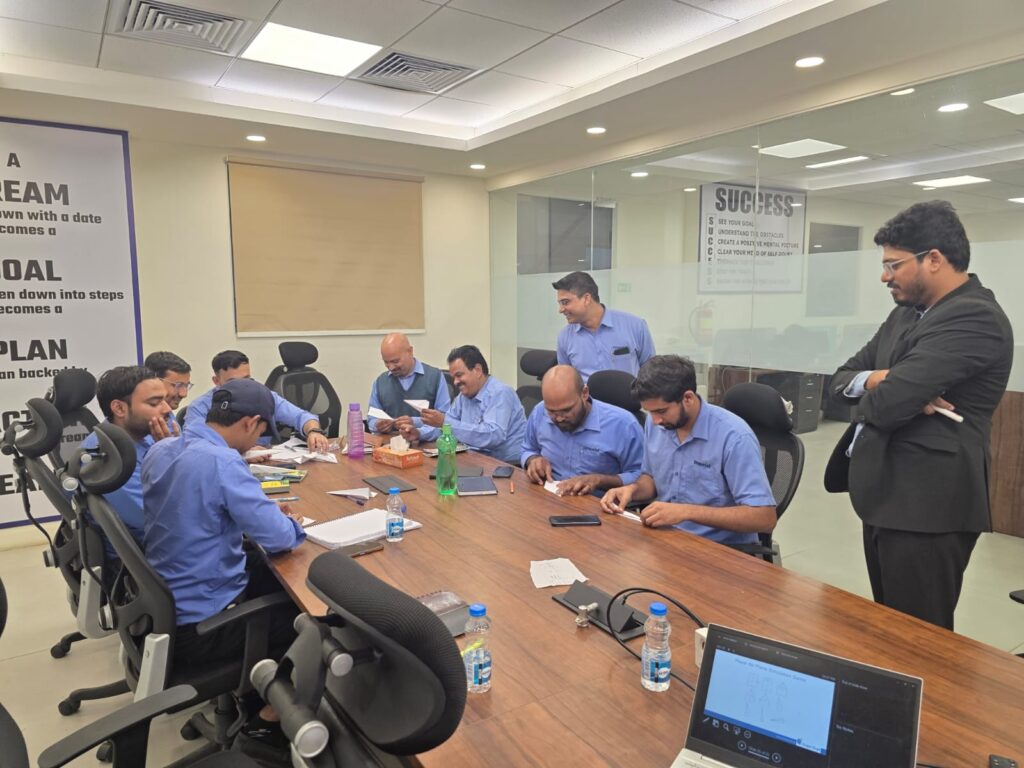
Building the base for the transformation: Kluger Kopf Partner ( Akshay Salunkhe ) building governance body
Quantifying Operational Excellence: From Hidden Inefficiencies to Measurable Gains
Within 90 days, the shopfloor had transformed—not just in output, but in behavior.
Production was no longer reactive.
It became planned, monitored, and controlled.
The impact was both visible and measurable:
- 52 sanctioned manpower reduction achieved through structural improvements
- 76 total manpower optimized across processes
- ₹1.03 Cr annual savings unlocked purely through manpower efficiency
But beyond numbers, the real shift was operational:
Production efficiency saw a 34% average improvement, with monthly gains reaching as high as 50% at peak.
Lines became balanced.
Workloads became predictable.
And most importantly—problems became visible early and solvable fast.
The shopfloor moved from firefighting to flow.
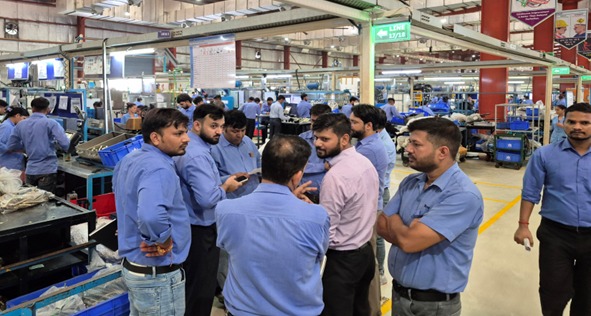
Kluger Kopf consultants (Chitrasen Singh) bringing transformation on the ground through handholding
What Made This Work
This transformation wasn’t driven by one breakthrough idea.
It was built on a few non-negotiable principles:
- Data before decisions – no assumptions, only measured reality
- Trial before scale – every change validated on ground
- Visibility drives behaviour – hourly tracking changed accountability
- Collaboration over enforcement – plant teams co-created solutions
- Structure enables speed – discipline first, optimization next
The Takeaway
In manufacturing, inefficiencies do not appear as failures—they exist as accepted inefficiencies.
This case study reinforces a simple truth:
Operational Excellence is not about working harder—it is about building systems that make performance inevitable.
The real win wasn’t reducing 52 people.
It was building a system where productivity no longer depends on firefighting.
At Kluger Kopf, we don’t just recommend strategy—we build execution engines that deliver it.
You may also like to read more buisines insights here.