
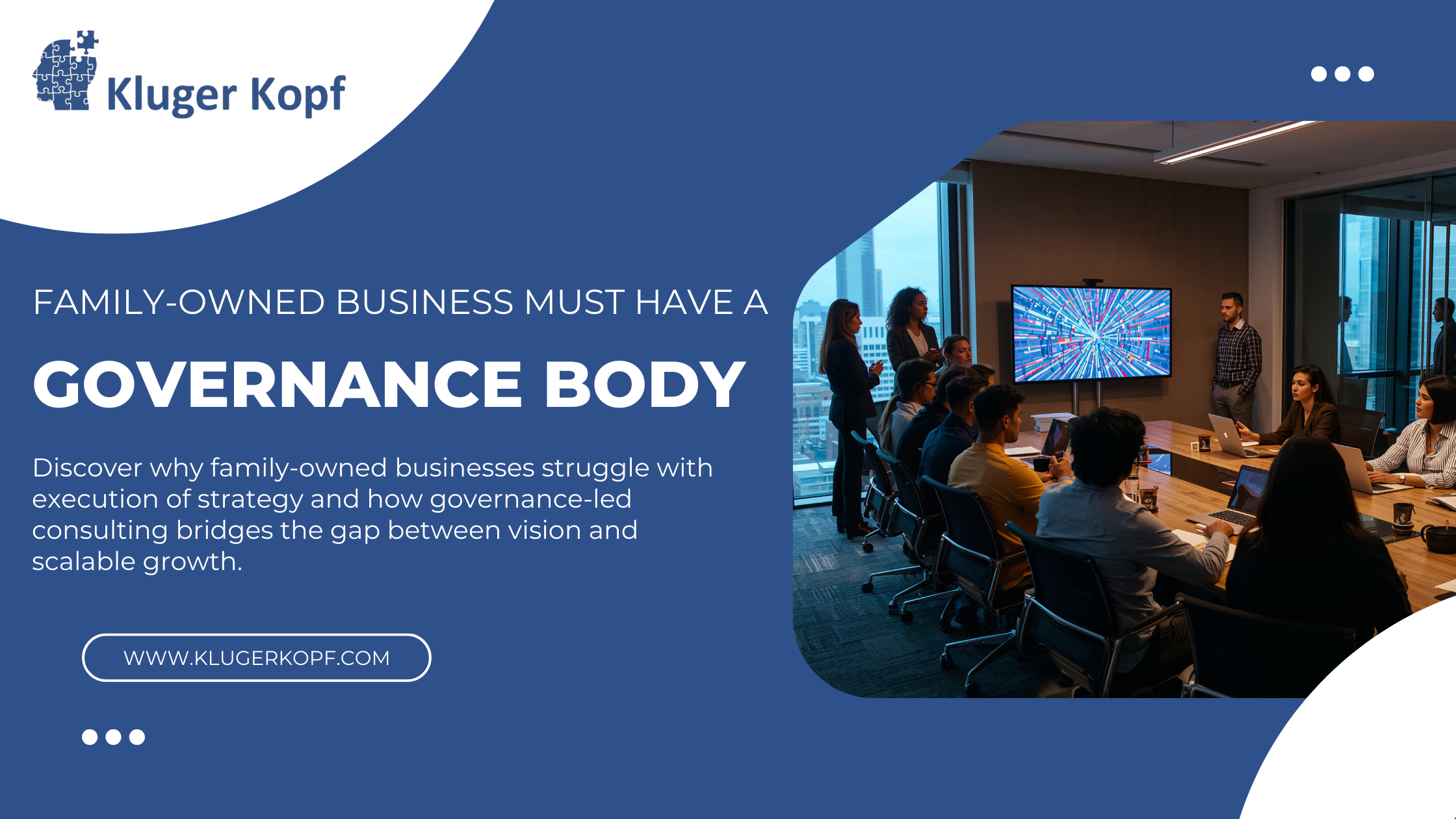
Family-owned businesses form the backbone of India’s economy. Most of them are built by formidable founders—leaders who relied on instinct, resilience, and relentless drive to create something meaningful from scratch. In their formative years, these businesses grow fast because decision-making is centralized, speed is high, and authority is unquestioned.
But as the organization matures, the very strengths that once powered growth begin to constrain it.
At Klugerkopf Consulting, we see this pattern repeatedly. Strategy discussions become frequent, ambition remains high, and yet execution weakens. Markets change faster than organizations respond. Processes remain static while competition innovates. The problem is rarely the absence of ideas—it is the failure in execution of strategy.
When Vision Becomes a Bottleneck
Most family-owned businesses continue to revolve around the alpha leader. While this leader may still be visionary, the organization around them often becomes structurally resistant to change.
Over time, layers of power emerge. Senior managers—many of whom have grown with the organization—learn to align themselves closely with the promoter’s thinking. Challenging ideas, dissent, or alternate perspectives quietly disappear. Meetings happen. Brainstorming occurs. But the final word almost always rests with the owner, and the organization learns that alignment matters more than originality.
This creates an invisible but powerful cultural outcome: comfort replaces curiosity.
Middle management becomes excellent at executing what is known, but deeply uncomfortable with what is new. Innovation slows not because people lack intelligence, but because the system discourages questioning. In such environments, execution of strategy becomes symbolic rather than real.
Why Strategy Fails in Owner-Driven Organizations
A common misconception in family businesses is that strong leadership automatically ensures strong execution. In reality, leadership without governance creates dependency, not scalability.
Execution of strategy is not an event—it is a system. And systems require structure, authority distribution, and disciplined review mechanisms.
This is where the idea of a governance body becomes essential.
Importantly, this governance body is not a board of directors, nor is it a compliance committee. Its purpose is not to monitor ongoing operations. Instead, it exists to create, drive, and institutionalize strategic change.
At Klugerkopf, we treat governance as the missing link between strategy formulation and execution-led consulting.
The Governance Body as an Execution Engine
An effective governance body brings together individuals who represent different forms of organizational capital—not hierarchy alone, but influence, credibility, and cognitive strength.
In every family-owned enterprise, there are individuals who hold power simply because they understand the system deeply. These leaders know the informal rules, the internal politics, and the emotional pulse of the workforce. Their authority often stems not just from designation, but from history. While they may be feared, they are also indispensable.
When such power-holders are excluded from transformation initiatives, resistance grows silently. When they are included and given defined execution roles, resistance converts into momentum. Their authority helps enforce discipline during uncomfortable phases of change—something no external consultant can achieve alone.
Alongside power, execution of strategy also depends on influence.
Every organization has people who are trusted not because of position, but because of integrity. Their colleagues listen to them. They create belief, not fear. These influencers play a critical role during transformation because they make change emotionally acceptable. They help people move through uncertainty and risk, not by instruction, but by example.
In our experience, no strategic initiative sustains without these informal leaders. They are the carriers of intrinsic motivation.
Finally, governance without intelligence becomes dangerous.
Execution requires thinkers who can design solutions, anticipate downstream impact, and challenge assumptions—including those of the promoter. Intelligent members of a governance body provide rational grounding to ambition. They test ideas before they become costly mistakes. They act as constructive skeptics, ensuring that execution is not blind, but deliberate.
For this reason, intelligent contributors must be given autonomy. Without the freedom to question legacy practices or play the devil’s advocate, governance collapses into compliance.
What Governance Is — And What It Is Not
One of the biggest mistakes family businesses make is turning governance bodies into parallel management layers. This dilutes authority and slows decision-making.
A governance body should not manage daily operations. It should not micromanage teams. And it should never override line leadership.
Its mandate is far more focused: own strategic initiatives and ensure their execution.
This includes setting execution priorities, reviewing outcomes instead of activities, removing bottlenecks, and recalibrating direction when reality diverges from plan. Governance exists to keep the organization alert, adaptive, and accountable.
Discipline Turns Vision Into Growth
For governance to enable real execution of strategy and consulting outcomes, it must operate with rhythm and discipline. Roles must be clear. Decision rights must be defined. Meetings must be purposeful and outcome-driven.
Monthly reviews are not about reporting—they are about learning. Progress is measured not in effort, but in impact. Objectives are refined continuously, keeping the organization responsive rather than rigid.
When owners, power-holders, influencers, and intelligent thinkers engage on a single execution platform, something powerful happens. Strategy stops being aspirational. It becomes operational.
Klugerkopf’s View: Execution Is the Only Strategy That Matters
In our consulting work with family-owned and owner-driven enterprises, one insight remains consistent: strategy rarely fails in the boardroom; it fails on the ground.
The answer is not more analysis or more control. The answer is governance-led execution—a system that respects the promoter’s vision while institutionalizing challenge, alignment, and accountability.
At Klugerkopf Consulting, we focus on the execution of strategy and consulting, helping family businesses move from intent to impact, and from founder-driven growth to institution-led scale.
Because in the end, growth does not come from ideas alone—it comes from the discipline to execute them.

One thought on “Family-Owned Business Must Have a Governance Body”